
Someone on your team probably still asks "what hashtags should we use?" before every post. Meanwhile the actual answer is: it depends way more on the platform than it did five years ago, and on most of them, hashtags are doing far less work than people think.
It comes up constantly with people posting to five or six networks at once, because the honest answer isn't one-size-fits-all. Do hashtags still matter in 2026? Yes, but the job they do has changed, and treating them the same on every platform makes your posts look out of place on at least two of them.
What hashtags actually do now
Hashtags used to be search terms. In 2026, they're closer to topic tags for the algorithm, not a discovery tool for humans scrolling and clicking tags.
Every major platform now leans on machine understanding of your actual content — the image, the video, the caption text itself — to decide who sees it. Hashtags are one more signal in that mix, but they're rarely the deciding one anymore.
That's a big shift from 2016-2020 Instagram, where stacking 30 hashtags in a comment was a legitimate growth hack. That era is over. The platforms got better at understanding content, and they stopped rewarding people for gaming a tag field.
Platform by platform, because they're not the same
This is the part people skip, and it's the part that matters most. Here's where hashtags still pull weight, and where they're basically decoration:
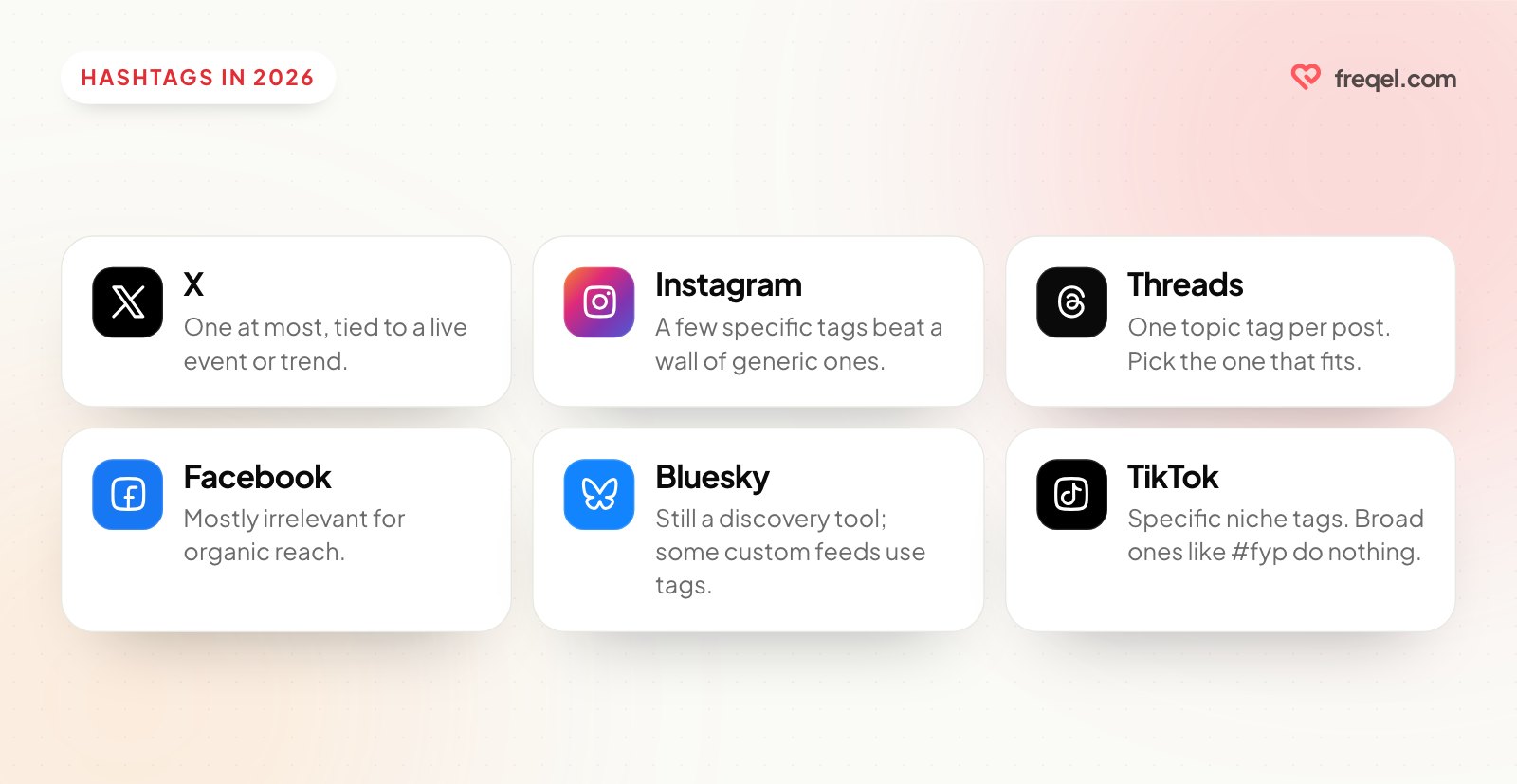
- X (Twitter): hashtags are close to dead for reach. One relevant tag tied to a live event or trending topic can help; more than that just clutters the post and can read as spammy.
- Instagram: still useful, but a few specific, relevant tags beat a wall of generic ones. Instagram's own creator account has long recommended 3 to 5, and the words in your caption do more for search than tag volume.
- Threads: a post gets one topic tag, not a block of hashtags. Pick the one topic people who'd care about the post actually follow; the rest of the discovery comes from the text itself.
- Facebook: mostly irrelevant for organic reach. Groups and Pages get more mileage from native engagement than from tags.
- Bluesky: hashtags actually still function like a discovery tool here, closer to old Twitter, because the network is smaller and custom feeds often filter by tag.
- TikTok: tags help categorize content for the For You algorithm, but broad tags like #fyp do nothing. Specific, niche tags perform better than anything generic.
Notice the pattern: the smaller or more text-search-driven the platform, the more a hashtag still functions like a search term. The bigger and more algorithmically-curated the platform, the less it matters.
The mistake almost everyone makes
Copy-pasting the same hashtag block across every platform is the single most common thing I see people do wrong. It's also the easiest habit to break.
Here's why it backfires:
- A 15-hashtag block that's normal on Instagram looks like spam on X or Threads.
- Generic tags (#love, #instagood, #marketing) signal low relevance to platforms that are trying to match content to genuinely interested viewers.
- Bluesky users can actually see and mute overused tags, so spammy tagging there has a real social cost, not just an algorithmic one.
The fix isn't more effort. It's different effort per platform — which is exactly the kind of small, repeated adjustment that's easy to skip when you're manually posting to six tabs and running out of patience by tab four.
What to actually do instead
Write your caption to be understood without any hashtags at all. That's the real shift for 2026 — the caption itself needs the keywords now, not just the tags bolted onto the end.
Then layer hashtags on top, per platform, using this rough approach:
- Write the core message in plain language, using the actual words people search for (not vague hype words).
- On Instagram and TikTok, add 3-5 specific tags tied directly to the content — niche beats broad every time.
- On X and Facebook, drop hashtags almost entirely, or use one if it's tied to a real conversation. On Threads, choose the single topic tag that fits best.
- On Bluesky, treat tags like mini search terms — think about what someone would actually type into a feed filter.
This is the workflow Freqel is built around. You write the post once, then adjust the caption and tags per platform with a preview of each version before you hit send, instead of sending the same block of 20 hashtags to Threads by accident because you were moving fast.
Tailoring per platform pays off twice
Adjusting tags per platform has a side effect that's worth more than the tags: it forces a quick look at every version of the post. That's when you catch the typo, the bad crop, or the joke that doesn't translate to another platform before it goes live everywhere at once.
The tagging habit is a small thing. But small friction, repeated every day across six platforms, is exactly what makes people quietly drop from posting everywhere to posting on one or two networks. More on that in keeping every platform active without living online.
So, do hashtags still matter in 2026?
Yes, selectively. Hashtags matter a lot on TikTok and Instagram if you keep them specific. They matter on Bluesky in a genuinely old-school, search-driven way.
They barely matter on X or Facebook, and using them heavily there makes posts look spammy. On Threads, one well-chosen topic tag is the whole game. The real skill in 2026 isn't picking hashtags — it's knowing which platforms still care.
If you want a deeper breakdown of caption length and tone per platform, see character limits on every platform, and for timing, the best times to post in 2026.
None of this requires more work, just smarter defaults per platform. That's the whole point of using a tool like Freqel: you write the post once, Freqel shows you a preview of each network's version, and you tweak the caption and tags for the two or three platforms that actually care — instead of manually redoing the whole thing six times or, more likely, giving up and posting to just one.
Try Freqel
Write once.
Post everywhere.
Schedule one post to Instagram, TikTok, YouTube, X, Threads, Facebook and Bluesky. 7 days free on every plan.