You post on Instagram. Then you switch tabs and post on X. Then Threads. Then Facebook, because your aunt still checks it. By the time you're done retyping the same caption five times, twenty minutes are gone and you haven't even picked today's hashtags yet.
This is the hidden tax nobody talks about when they tell you to "be consistent on social media." Consistency isn't the hard part. The hard part is the tab-switching, the re-uploading, the re-cropping images five different ways. Scheduling social posts from one place fixes exactly that, and the time savings are bigger than most people expect.
The real cost of posting one platform at a time
Say you post to four platforms a day. Each one takes maybe five minutes once you count logging in, writing the caption, uploading media, and hitting publish. That's twenty minutes a day, seven days a week.
Twenty minutes a day, every day, is over two hours a week and more than 120 hours a year, on the mechanics alone. Your numbers will differ; the shape won't.
Now add the mental overhead. Switching between apps costs you focus, not just minutes. Every tab switch is a tiny context reset: you re-read your caption, second-guess the wording, maybe get distracted by a notification.
What actually eats your time (it's not the writing)
People assume the bottleneck is coming up with content. Usually it isn't. Here's where the hours actually go:
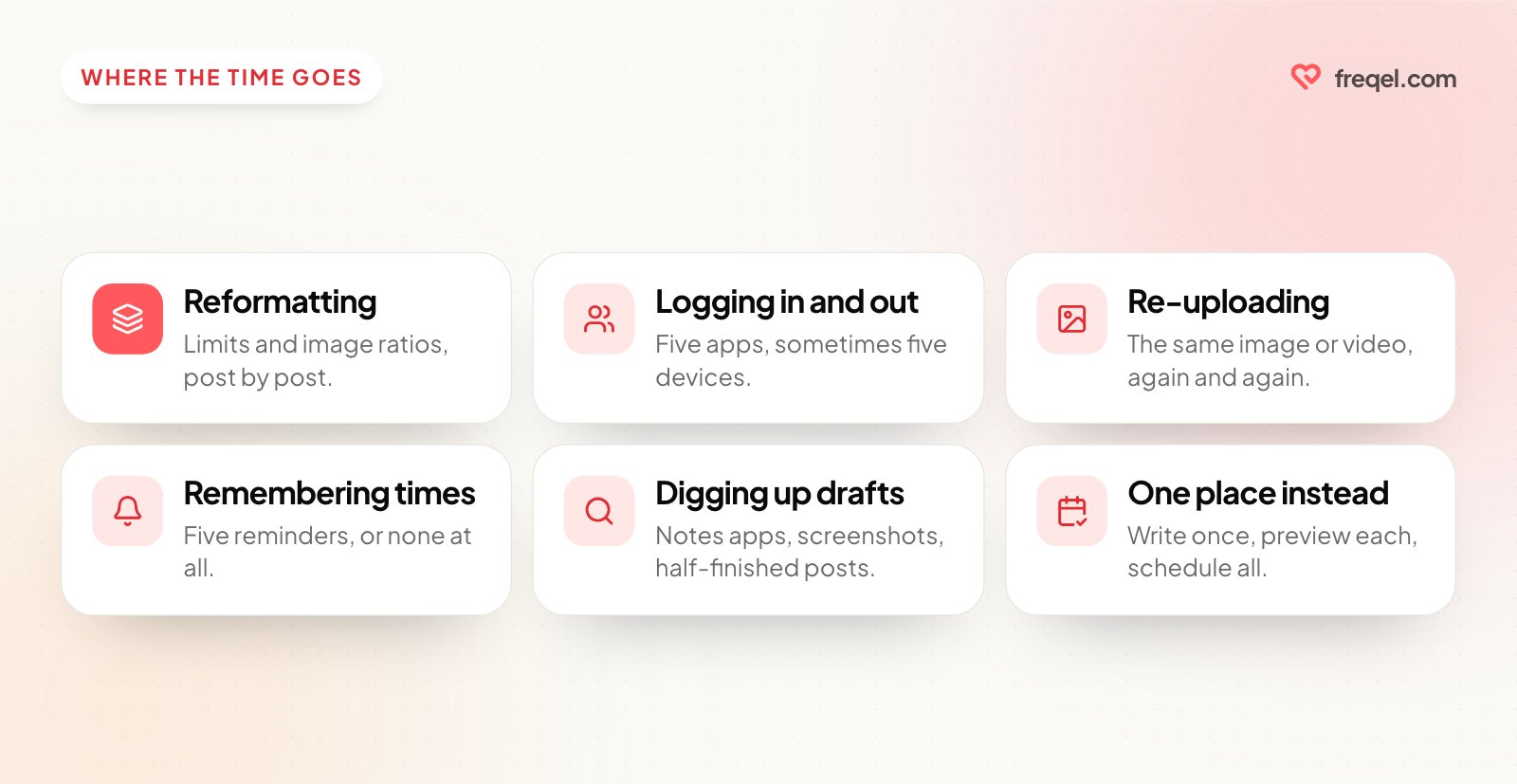
- Reformatting the same post for each platform's character limits and image ratios
- Logging in and out of five different apps, sometimes on five different devices
- Re-uploading the same image or video over and over because each platform wants its own upload flow
- Remembering to post at the right time for each platform's audience, which usually means setting five separate reminders — or forgetting entirely
- Digging up old drafts scattered across notes apps, screenshots, and half-finished tweets
None of this is creative work. It's plumbing. And plumbing is exactly the kind of thing that should be automated, not repeated by hand every single day.
Scheduling social posts from one place changes the math
When you schedule social posts from one place, you write the post once. You tweak the caption per platform if you want — maybe X gets a punchier version, Instagram gets the hashtags — but the media, the timing, and the publishing all happen from a single screen.
This is where a tool like Freqel comes in. You write a post once, see a preview of each network's version, adjust the wording where it matters, and schedule it in one pass. No tab-switching. No re-uploading the same video six times. No sticky notes reminding you to post at 6pm.
The batching effect matters too. When you sit down once a week to schedule 15 posts across every platform, you're in "content mode" the whole time — same mindset, same momentum. Compare that to posting piecemeal every day, where you have to mentally switch back into content mode from whatever else you were doing.
Why posting to fewer platforms isn't the answer
The tempting shortcut is to just post less often, or only on one platform. Pick your favorite, ignore the rest. It sounds efficient. It isn't.
Your audience is fragmented across networks whether you like it or not. Some people only check Threads. Others live on Bluesky now. Every platform you skip is an audience you're leaving on the table, not a task you've successfully avoided.
The better move is to keep posting everywhere, but stop doing it manually. That's the whole point of cross-platform scheduling: it lets you show up on every channel without the time cost scaling linearly with each new platform you add.
What a realistic weekly workflow looks like
Here's what a lot of creators and small marketing teams actually do once they consolidate their posting:
- Block 45–60 minutes once a week to plan and draft content
- Write each post once, then adjust wording per platform where it genuinely helps
- Check the preview and character count for each network before scheduling, so nothing gets cut off
- Schedule the whole week's posts across every channel in one sitting
- Spend the rest of the week just replying to comments, not publishing
That's it. One planning session replaces five daily interruptions. If you want a deeper breakdown of how to structure that weekly block, we wrote about it in a weekly content system for solo creators.
Getting the per-platform details right without starting from scratch
One worry people have with cross-posting tools: won't everything look copy-pasted and generic? Fair concern — a caption built for X often reads badly on Instagram, and vice versa.
The fix isn't posting manually again. It's editing per platform from the same base post, instead of rebuilding it from zero each time. Shorten the caption for X, add the hashtag block for Instagram, drop a link in for Facebook. You're still writing once — you're just polishing five times instead of drafting five times.
This is also where timing differences matter. Your audiences may not be active at the same hours on every network; when one clearly peaks elsewhere, schedule that version as its own post. If you want specifics, read the best times to post.
Doing the math on your own week
Try this: track how long you spend posting manually for one week. Include login time, uploads, retyping, and the mental reset between apps. Most people are surprised by the number.
Then imagine that time cut to a fraction, because you're writing once and previewing everything before it goes out. That's not a hypothetical — it's the exact gap between manual posting and scheduling from one place.
If you're managing content for a client or a small team, this gap compounds fast. Ten posts a week across four platforms is 40 individual publishing actions. From one place, it's ten. For more on running several channels, read how to run six brand channels without burning out.
None of this requires you to post less, care less, or lower your standards per platform. It just means the busywork stops eating hours that should go toward actually growing your audience. That's the entire idea behind Freqel: write the post once, fine-tune it per platform, and schedule everything from one place instead of a dozen open tabs.
Try Freqel
Write once.
Post everywhere.
Schedule one post to Instagram, TikTok, YouTube, X, Threads, Facebook and Bluesky. 7 days free on every plan.