You wrote a great post. Then you spent twenty minutes reformatting the same 40 words for five different apps, cutting hashtags for one, adding them back for another, and shrinking a caption because Threads cut it off mid-sentence.
That's the real cost of posting everywhere. It's not the writing. It's the copy-paste tax you pay on every single post, every single day. This post is about how to write one post and adapt it per platform without losing your evening to tab-switching.
Write the core idea before you write the post
Most people start writing directly in the platform's box. That's the mistake. You end up shaping your idea around a character limit before you even know what the idea is.
Instead, write the core message somewhere neutral — a notes app, a doc, or a tool that isn't tied to one network. One sentence: what's the point of this post?
- The hook — the first line that stops a scroll
- The point — the one thing you want the reader to take away
- The ask — reply, click, save, follow, whatever it is
Once those three things are locked, the platform-specific version is just reformatting, not rewriting. That distinction is what saves you time.
Know what actually changes between platforms
Not everything needs to change. In fact, most of your post can stay identical across networks. What changes is small, but it matters.
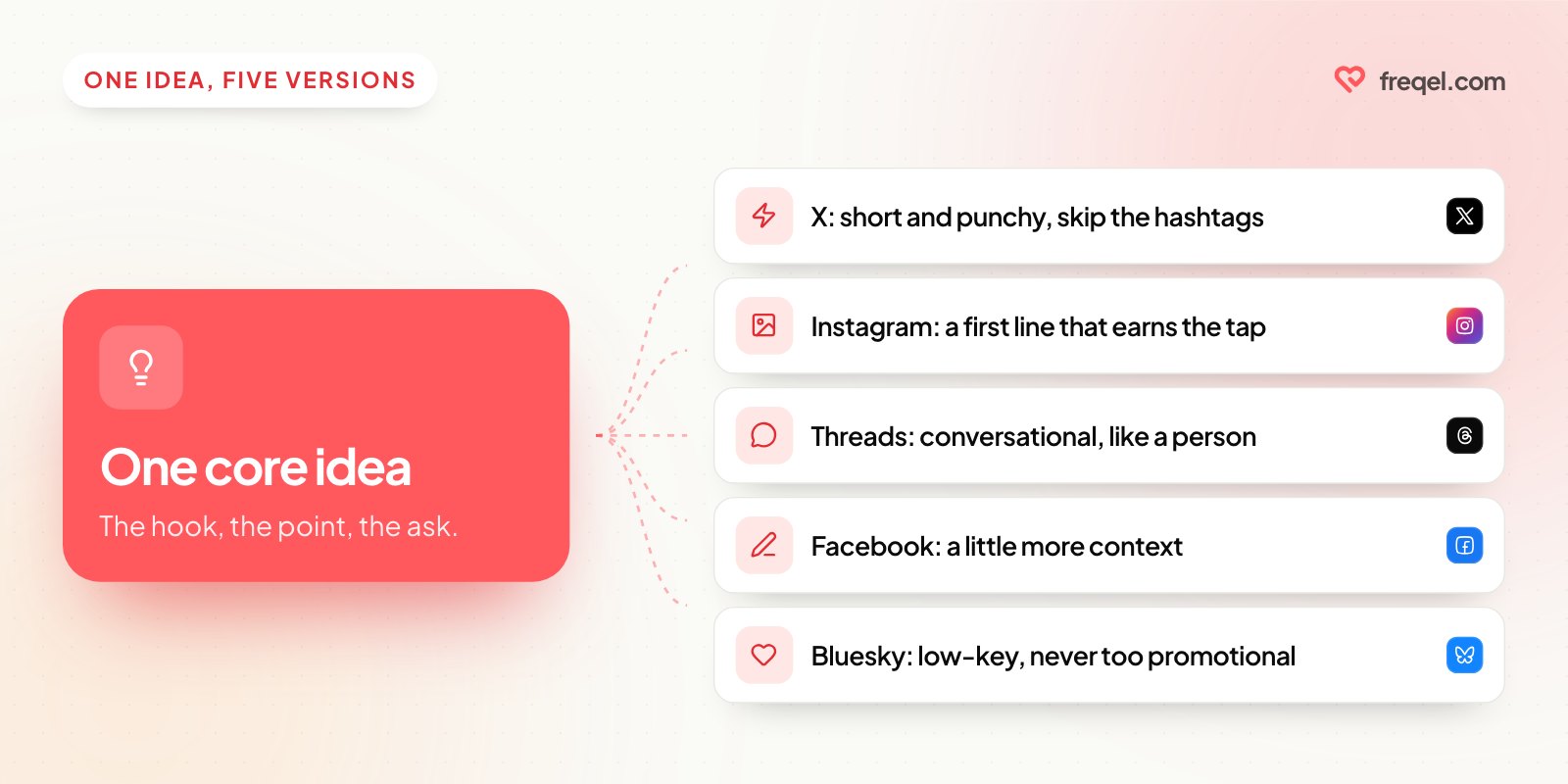
- X — short, punchy, thread-friendly. Hashtags feel dated here now; skip them.
- Instagram — caption can be longer, but the first line has to earn the tap on "more." Hashtags still pull weight.
- Threads — conversational tone works best. Feels weird if it reads like a press release.
- Facebook — audiences there tend to skew older than on TikTok or Threads, and a little more context is fine, even welcome.
- Bluesky — small, close-knit communities. Overly promotional posts get called out fast.
Once you know the pattern, you're not thinking from scratch each time. You're just running your core message through five known filters.
Build around the tightest constraint, then expand
Write your first draft as if it has to fit X's limit. Short forces clarity. It's much easier to add context for Facebook than to cut a paragraph you're attached to.
This also protects your hook. If your first line survives being squeezed into 280 characters, it'll survive everywhere else too. A bloated opener is one of the easiest ways to get scrolled past.
How to write one post and tweak it for each platform without the busywork
Here's the actual workflow that removes the tax. This is the part most people skip because they think it needs to be manual.
- Write the core post once — hook, point, ask.
- Drop it into a tool that shows a preview per platform, so you can see exactly how it'll render before it's live.
- Tweak wording only where the platform demands it — trim for X, add a line for Facebook, adjust tone for Threads.
- Swap media per platform if needed — square crop for Instagram, wider for X.
- Schedule all versions at once instead of logging into five apps.
This is exactly the gap a tool like Freqel was built to close. You write the post once, then tweak the caption per platform next to a preview of that platform's version, with its character count against its limit.
No switching tabs to check if your caption got cut off. No re-uploading the same image five times. You adjust what needs adjusting, then schedule everything, or post it now, from one place.
The mistakes that quietly kill cross-posting
Most cross-posting fails aren't dramatic. They're small habits that add up and make your accounts feel inconsistent or lazy.
- Literal copy-paste — same hashtags on X as Instagram, same tone on Facebook as Threads.
- Cutting the hook instead of the middle — you trim the wrong part when you're rushing to fit a limit.
- Ignoring crop ratios — a great photo looks awkward when it's cropped wrong for the platform.
- Posting at one time for all platforms — audiences on each network are awake and scrolling at different hours.
- Skipping platforms because tweaking feels like too much work — which quietly shrinks your reach over time.
That last one is the sneaky one. Nobody decides to abandon a platform. They skip it "just this once" because tweaking feels like work, and a five-platform plan quietly becomes one.
If scheduling is your next bottleneck once the writing is sorted, we covered timing in the best times to post, and formatting per platform in post formatting for Instagram, Threads and X.
Test your tweaks like you'd test anything else
Not all tweaks are equal. Some matter a lot; some are habit, not strategy. Track engagement per platform for a month before deciding your tweaks are actually helping.
A simple test: post the exact same caption everywhere for two weeks. Then run tailored captions for two weeks. Compare engagement rate, not just raw likes — followers per platform vary wildly.
If you want a deeper breakdown of what to look for, read what makes a post perform well on every platform.
Writing once and tweaking per platform isn't about doing less work — it's about doing the right work once instead of the same work five times. Nail the core message, know what actually needs to change per network, and let a tool handle the repetitive part. That's the whole point of Freqel: write it once, preview it everywhere, tweak what matters, and schedule the rest without opening a single extra tab.
Try Freqel
Write once.
Post everywhere.
Schedule one post to Instagram, TikTok, YouTube, X, Threads, Facebook and Bluesky. 7 days free on every plan.